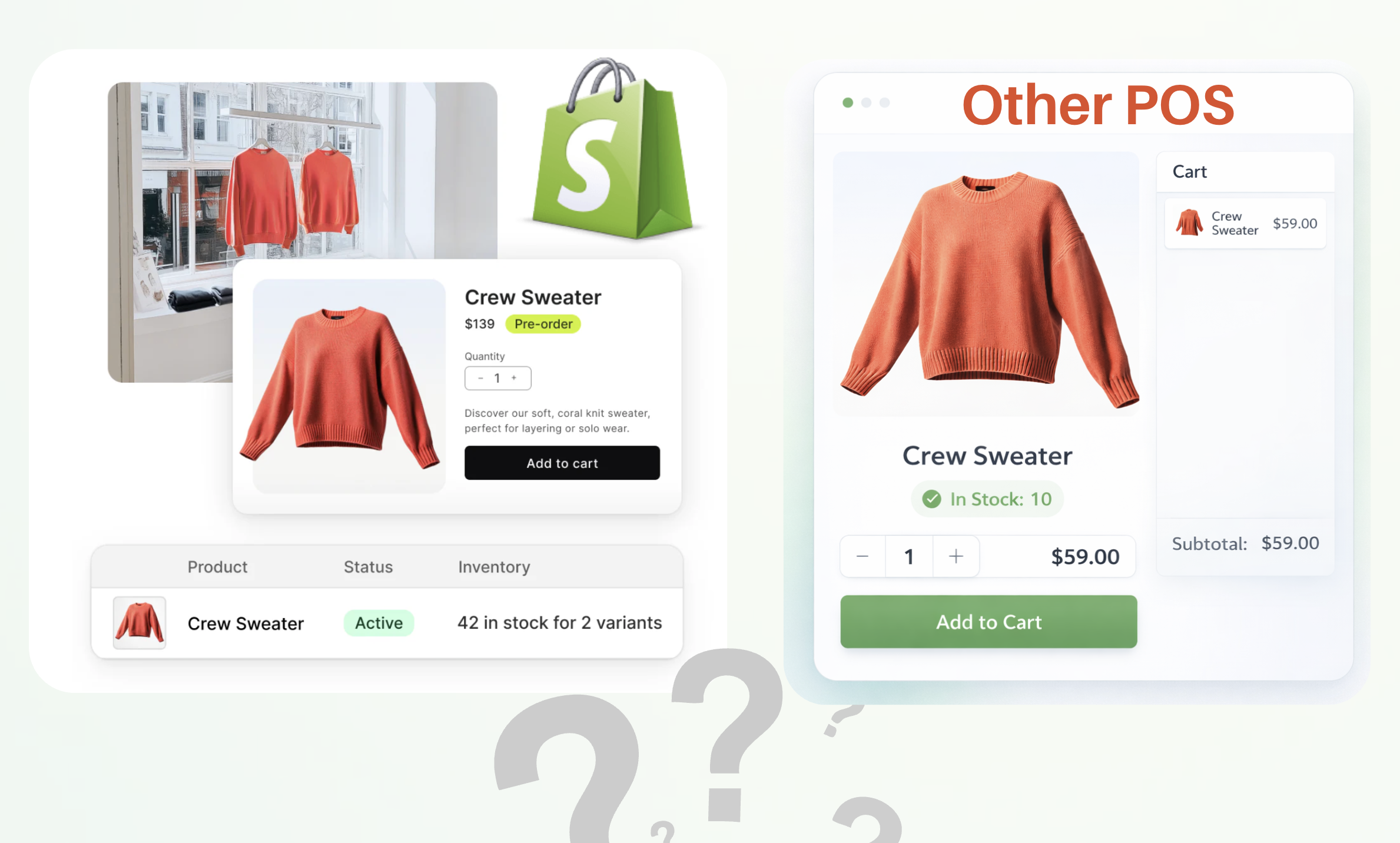
Stock mismatches are one of the most frustrating problems in retail.
A product shows as available online, but the store cannot find it. A customer places an order, but the branch that is supposed to fulfill it is already out of stock. A team member adjusts inventory in one place, but the other system still shows the old quantity.
These problems do not just create confusion. They affect order fulfillment, customer trust, staff efficiency, and day-to-day decision-making.
For retailers selling through Shopify and physical stores at the same time, stock mismatches usually happen because inventory is being updated across multiple places, but not through one reliable workflow.
The good news is that most stock mismatches are preventable once you understand where they come from.
What a stock mismatch actually means
A stock mismatch happens when the quantity shown in one system does not match the quantity physically available in the business.
That difference can appear in several ways:
- Shopify shows stock that the branch no longer has
- the store has stock physically, but the system shows it as unavailable
- one branch shows quantity that was actually transferred elsewhere
- returned or exchanged items are not reflected correctly
- total stock looks correct, but branch-level stock is wrong
This is why inventory accuracy is not only about having numbers in the system. It is about making sure those numbers reflect what is actually happening across stores, counters, transfers, and online orders.
Why this problem gets worse as retail grows
A single-store business can often manage inventory with simpler habits. There are fewer moving parts, fewer people adjusting stock, and fewer channels to keep aligned.
Once a retailer grows into multiple branches, the inventory process becomes much more operational.
Now the business may be dealing with:
- Shopify orders
- in-store billing
- stock transfers between branches
- warehouse replenishment
- exchanges and returns
- manual adjustments
- branch-wise availability decisions
Every one of those actions can affect stock.
If they are not connected properly, the system slowly drifts away from reality.
That is why multi-location retailers need stronger inventory management across locations, not just a basic stock count.
1. Sales happen in one place, but updates lag in another
One of the most common reasons stock mismatches happen is simple delay.
A product gets sold in-store, but the online quantity does not reflect it quickly enough. Or a Shopify order reduces inventory, but the branch team does not immediately see the impact on local availability.
These delays may seem small at first, but they create real problems:
- overselling
- cancelled orders
- branch confusion
- manual stock corrections later
The more often online and offline sales happen together, the more dangerous delayed sync becomes.
Retailers need a workflow where store activity and Shopify activity do not behave like separate worlds.
That is where Shopify Retail POS Integration becomes important, because it brings inventory actions closer to real operational activity.
2. Total stock looks fine, but branch stock is wrong
Many businesses know their total stock quantity.
The real issue is that they do not always know how that stock is distributed across branches.
For example, a product may show ten units in total, but only one branch may have those units physically. If Shopify shows availability without proper branch-level visibility, the business can make the wrong fulfillment decision.
This is one of the biggest inventory mistakes in multi-store retail.
Total stock is useful for reporting.
Branch-wise stock is what matters operationally.
Without branch-level visibility, teams start making assumptions such as:
- "maybe the other branch has it"
- "it should be in stock somewhere"
- "the system shows quantity, so let us accept the order"
That is exactly how fulfillment issues begin.
A stronger multi-branch inventory and order management workflow helps solve this by showing where stock actually exists, not just how much exists overall.
3. Transfers between locations are not tracked properly
Inventory rarely stays in one place forever.
Retailers often move stock:
- from warehouse to branch
- from one branch to another
- from receiving stock to sellable stock
- from return flow back into available stock
If these movements are not logged clearly, stock starts drifting.
A common example looks like this:
One branch sends stock to another branch. The sending side records it mentally or in a spreadsheet. The receiving side confirms it later, or forgets to. Meanwhile, Shopify or the POS still shows the old availability.
That creates a mismatch even though the stock physically exists.
The problem is not always missing stock. Sometimes it is missing visibility.
This is why multi-location and branch inventory transfer is not just a nice feature. It is a core control point in accurate retail inventory.
4. Returns are handled loosely
Returns can easily break inventory accuracy when businesses do not follow a clear process.
When a product comes back, several questions matter:
- Is the item sellable?
- Should it return to the same branch?
- Should it go into hold, inspection, or damaged stock?
- Has the system been updated yet?
- Was the original sale online or in-store?
If these questions are not handled consistently, the system may show stock that should not be sellable yet, or fail to return stock that is actually available.
Over time, these small return mistakes add up.
What feels like a one-off issue becomes a recurring mismatch pattern.
5. Exchanges are even more complicated than returns
Exchanges are one of the most overlooked causes of inventory errors.
That is because an exchange usually affects at least two product movements:
- the original item comes back
- the replacement item goes out
Sometimes those movements involve different sizes, different SKUs, or even different branches.
If the exchange is handled casually, the business may:
- put returned stock back incorrectly
- miss reducing the replacement item
- break order history
- lose track of which location actually handled the exchange
This creates inventory errors that are harder to notice than simple sales mismatches.
A retailer may think stock is accurate until a later count reveals that exchange activity quietly distorted several quantities.
6. Staff rely on spreadsheets, chat, or memory
This is extremely common in growing retail businesses.
A team starts with simple manual coordination because it feels fast:
- staff message each other on WhatsApp
- someone updates a spreadsheet later
- branch managers remember transfer activity manually
- store teams tell each other what was sold or moved
This can work for a very small setup.
It usually fails once the business has multiple people, multiple locations, and both online and offline sales happening all day.
The biggest issue with manual coordination is not only delay. It is inconsistency.
Different people follow different habits, and inventory becomes dependent on whether someone remembered to update the right place at the right time.
That is not a strong enough system for multi-branch retail.
7. Online order fulfillment is chosen without live stock visibility
A Shopify order comes in.
Now the business needs to decide which location should fulfill it.
If that decision is made without live branch stock visibility, several things can go wrong:
- the wrong branch gets assigned
- the selected location cannot fulfill the order
- staff discover the problem late
- the order must be rerouted manually
- stock gets adjusted after the fact
This is not just an order routing problem. It is an inventory accuracy problem too.
When fulfillment decisions are disconnected from real stock visibility, the system stops reflecting what is actually happening in branches.
That is why Shopify order fulfillment through POS matters so much for multi-location retailers.
8. Warehouse stock and branch stock are treated as the same thing
Another common source of mismatch is mixing central stock and branch stock without enough structure.
A business may have plenty of stock overall, but that does not mean every branch can sell it immediately.
Warehouse stock and branch stock serve different operational purposes.
Warehouse stock is usually for storage, replenishment, and distribution.
Branch stock is what supports local selling and order fulfillment.
When those are blended together too loosely, retailers can end up with:
- branches appearing more stocked than they really are
- replenishment happening too late
- Shopify orders being assigned based on total stock instead of local availability
- confusion about where products are actually located
That is why retailers need clear location logic, not just one combined quantity.
9. Manual stock corrections hide the real cause
When mismatches happen often, many teams fall into the habit of fixing the numbers manually.
Someone notices an issue and simply adjusts the quantity.
That may solve the immediate problem, but it does not solve the workflow problem that created it.
Manual correction hides the real cause:
- delayed sales sync
- unclear transfer handling
- weak return processes
- branch visibility issues
- poor fulfillment decisions
If a business keeps "fixing the count" without improving the process, the same mismatch will come back again.
In other words, manual correction treats the symptom, not the source.
What a healthier inventory workflow looks like
To reduce stock mismatches, retailers need more than software connections. They need a cleaner operating model.
A healthier workflow usually includes:
Branch-wise stock visibility
Teams should know how much stock is available in each branch, not just across the business overall.
Clear transfer records
Inventory moving between locations should be logged and confirmed properly.
Better return and exchange handling
Returned and exchanged items should follow a clear process, so stock goes to the correct place and state.
Fulfillment based on real availability
Shopify orders should be routed using live location data, not assumptions.
One connected operational flow
Sales, transfers, fulfillment, and stock movement should support each other instead of creating separate versions of the truth.
This is where a stronger multi-location inventory management approach helps retailers stay accurate as they grow.
How iSmartSync helps reduce stock mismatches
iSmartSync is designed for retailers dealing with real multi-branch complexity.
Instead of treating inventory as one flat total, it helps businesses manage stock with better branch visibility, clearer movement tracking, and tighter alignment between Shopify and physical operations.
That means retailers can get more control over:
- branch-wise availability
- operational stock movement
- Shopify-connected inventory decisions
- fulfillment visibility
- transfer-driven stock updates
This is especially important for businesses trying to scale without relying on spreadsheets, chat-based stock coordination, or after-the-fact corrections.
To explore related workflows, you can also look at:
- Shopify Retail POS Integration
- Multi-Location Inventory Management
- Multi-Location and Branch Inventory Transfer
- Shopify Order Fulfillment Through POS
Final thoughts
Stock mismatches between Shopify and physical stores usually do not come from one big mistake.
They come from small breaks in the workflow:
- delayed updates
- unclear location visibility
- weak transfer handling
- messy returns
- untracked exchanges
- manual coordination
- poor fulfillment decisions
When these gaps pile up, inventory becomes harder to trust.
Retailers that solve this early create a big advantage. They fulfill more accurately, reduce manual correction work, and give both staff and customers a more reliable experience.
If your business is already selling through Shopify and physical stores, reducing stock mismatches is not just about better reporting. It is about building a workflow that keeps inventory aligned across every location.